
Deck planning guide
Deck replacement: new boards, a new frame or a whole new deck?
It depends on the frame under the boards. If the posts, beams, joists, ledger and footings are sound and built correctly, new deck boards, railings or stairs may be enough. If the frame is rotting, loose, or attached to the house the wrong way, the deck usually needs more than a new surface. You can’t tell which from the top of the deck, so the frame has to be checked in person.
Call Tanner: 734-259-4649Request an estimate
Can I just replace the deck boards?
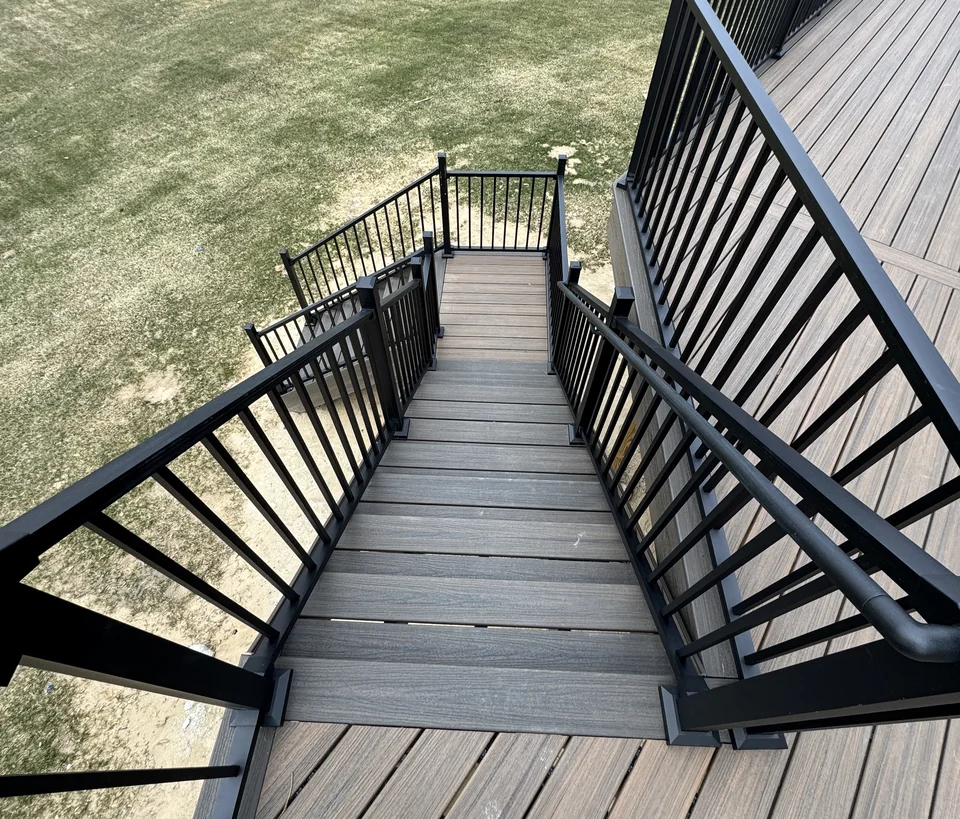
Yes, if the frame underneath is in good shape. New boards on a sound frame is the smallest kind of deck replacement. Railings and stairs can often be replaced the same way.
Two things to check first:
- The frame has to be worth keeping. New boards won’t fix a soft joist, a loose ledger or a sinking post. The warning signs are below.
- The new boards have to suit the frame. Composite boards must be installed according to the manufacturer’s instructions, and those instructions set how far apart the joists can be. Livonia’s deck guide says this too. If you’re switching from wood to composite, the existing joist spacing may decide which products work.
In some towns, even a board-only job needs a permit. Canton is one of them (see the permit section below).
How do I know if my deck frame needs replacing?
Look underneath. The North American Deck and Railing Association (NADRA) suggests checking several spots: the ledger board where the deck meets the house, the support posts, the joists, the deck boards, the railings and the stairs. NADRA calls the ledger “a common source of deck failure.”
Signs the frame may need repair or replacement:
- Soft or decaying wood. NADRA’s test: push an ice pick or screwdriver into the wood. If it sinks in a quarter to half an inch easily, the wood feels soft and spongy, or a sliver breaks off without splintering, decay may be present. Check damp spots and wood around fasteners first.
- Small holes in the wood. NADRA says these may point to insects.
- A ledger held on with nails only. NADRA says the ledger shouldn’t be fastened with only nails. The American Wood Council’s deck guide (DCA 6) calls for half-inch lag screws or bolts at the ledger.
- Missing or failing flashing at the house. Flashing directs water away from the gap between the deck and the house. NADRA says to replace or add flashing where water is collecting. DCA 6 calls for corrosion-resistant flashing at the ledger.
- A ledger attached to brick, stone, a cantilevered overhang or a bay window. DCA 6 doesn’t allow these attachments. A deck in that situation needs its own support away from the house wall instead.
- Shallow or unknown footings. Michigan’s residential code says exterior footings must go 42 inches below grade unless the building official approves otherwise. Older decks sometimes sit on shallow footings or blocks on the ground.
- Beams bolted to the side of posts. DCA 6 says beams should sit in a notch in the post or on a post cap, and it doesn’t allow a beam fastened to the side of a post without a notch.
- Rusty or loose fasteners. NADRA says a corroded fastener can damage the wood around it.
- Sagging, swaying or movement. NADRA says the deck and stairs should look even, without sagging, and shouldn’t sway or move when tested.
- Loose railings or decayed stairs. Railings should be firmly held in place, and stair stringers and risers shouldn’t be loose or decayed.
Should I keep the frame or replace the whole deck?
Keep the frame only if it’s sound and built well enough to carry the new deck for years. Replace it when the warning signs above show up in the structure, not just on the surface.
Things that push toward a full replacement:
- Rot or damage in several joists, the beam, the posts or the ledger.
- A ledger attachment or footings that don’t meet today’s rules.
- Plans to change the size, height or shape. A new layout usually means a new frame layout too.
- A switch to decking that needs closer joist spacing than the old frame has.
Reusing an old frame only works if it’s sound, and that has to be checked in person. A photo can’t show it. For the full list of things a photo can’t show, see What determines the cost of a deck?
What happens when an old deck is torn out?
The old boards, railings and stairs come off first. That exposes the frame, so this is when any hidden damage shows up.
- At the house wall. When a ledger is replaced, DCA 6 says the siding or exterior finish must come off where the ledger goes, and flashing goes in. Damaged siding or sheathing behind an old ledger sometimes only shows up at this stage.
- Below the deck. Old posts and footings come out if the frame is being replaced. New footings are dug and, in many towns, inspected before concrete is poured (see the permit section).
- Haul-away. The old material has to be removed and disposed of, which takes time and is part of the job.
If hidden damage turns up, our cost guide explains how it’s handled: work on that part stops until you approve the added cost.
Do I need a permit to replace a deck or deck boards?
Often, yes. It depends on your city or township, and some require a permit even for new boards.
To compare 11 local towns side by side, see deck permits by town.
- Canton Township: yes, even for boards. Canton’s “Do I need a permit?” list includes “decks and any replacement of deck guardrails, deck boards, steps, or structure.” Canton’s deck handout lists a post hole inspection and a final inspection for deck construction.
- Plymouth Township: yes. The Township says you need a building permit to install or repair a deck.
- Livonia: Livonia says you generally need a building permit when you build, alter, repair or remove a structure. Its deck guide lists a post hole and ledger inspection, an open joist inspection for low decks (less than 4 feet between the joists and the ground), and a final inspection.
- City of Plymouth and other towns: ask the building department before work starts. Rules vary, and the City of Plymouth and Plymouth Township are separate municipalities with separate departments.
If you have an HOA, check with it too. Canton’s deck handout says HOA approval must be obtained before construction.
What changes the cost of a deck replacement?
Mostly how much of the old deck can stay. A board-only job and a full tear-out and rebuild are very different projects, even on the same footprint.
- How much of the frame is reusable. Boards only, boards and railings, or everything down to the footings.
- Hidden damage. Rot at the ledger, the house wall or the posts that shows up during tear-out.
- Tear-out and disposal. The size of the old deck and how hard it is to remove.
- Size, height and shape. Especially if they change.
- Decking and railing materials. See our deck material and maintenance guide.
- Stairs and landings. How many, and whether they’re being rebuilt.
- Site access. How easily material can get to and from the backyard.
- Permits, drawings and inspections. These vary by town.
Deck replacement questions
Can I put new composite boards on my old wood frame?
Sometimes. The frame has to be sound, and the joist spacing has to match what the composite manufacturer requires. If the spacing is too wide, the frame needs changes first.
Can I replace only the railings or the stairs?
Often, if the frame they attach to is sound. Check the permit rules first: Canton lists replacing deck guardrails and steps as work that needs a building permit.
Is a deck that looks fine on top safe underneath?
Not always. A good-looking surface doesn’t tell you what the ledger, joists and posts are like. That’s why NADRA’s checklist starts with the structure under the deck.
Do you repair old decks, or only replace them?
Both. We take on deck repairs, rebuilds and new decks. Tell us what’s wrong now, like a soft board, a loose railing or worn stairs, and we’ll talk through the options.
Can I send photos before a visit?
Yes. Text them to 734-259-4649 with your name. A wide shot from the yard, a shot of where the deck meets the house, and a few close-ups from underneath help most. Photos help us prepare, but they can’t confirm whether the frame can be reused.
Before you plan
Ready to talk about replacing your deck? Call or text Tanner at 734-259-4649, or send the estimate form. Tell us your city or township, what’s wrong with the deck now, and whether you’d like to keep the same size or change it. Email: [email protected].
Request an estimate734-259-4649