
Deck pricing
What sets the cost of a deck in Michigan?
Two decks with the same footprint can be priced very differently. The price comes from the work itself: how big and how high the deck is, what it is built from, and what has to happen on site before the first board goes down. Here is what moves the number, so you can plan your project and compare estimates fairly.
The short answer: size, height and materials.
Those three details shape most of the price, which is why they are the first things we ask about. Everything else on this page moves the price up or down from there.
Nine things that change the price.
Scroll sideways to see the whole table.
| Factor | Why it changes the price | What to tell us |
|---|---|---|
| Size and shape | More square footage means more framing, decking and labor. Angles, curves and multiple levels add cutting and fitting time. | Rough length and width, and any shape you have in mind. |
| Height off the ground | A higher deck needs taller posts, more bracing, longer stairs and railings on every open side. | About how high the deck would sit at the door. |
| Decking material | Pressure-treated wood usually costs the least up front. Composite costs more, and premium composite lines cost more again. | Wood, composite, or undecided. |
| Railings | Railing style and material change the price per foot, and a higher deck usually needs more railing. | Any railing style you like, or a photo of one. |
| Stairs and landings | Each step, landing and change of direction adds framing and railing work. | Where you want to step down to the yard. |
| The existing deck | Tear-out and disposal take time. Reusing an old frame only works if it is sound, and that has to be checked in person. See our deck replacement guide. | Whether there is an old deck, with photos of it. |
| Site access | Tight side yards, slopes, fences and landscaping slow down delivering and moving materials. | How a crew would reach the work area. |
| Permits and inspections | Many decks need a building permit, drawings and inspections, and the rules differ by city and township. | Your city or township, and any HOA rules. |
| Extra features | Built-in benches, skirting, lighting, a pergola or a roof add materials and labor. | Your must-haves and your nice-to-haves. |
Size and shape: start with the footprint.
Square footage sets how much framing, decking and labor go into a deck. Here is the area of four sizes people ask about:
- 12x12 deck: 144 square feet.
- 14x20 deck: 280 square feet.
- 16x20 deck: 320 square feet.
- 20x20 deck: 400 square feet.
Size is only part of the price. Height, stairs, railing and material can move the price as much as size. Shape matters too: angles, curves and more than one level add cutting and fitting time.
Before you settle on a size, measure the furniture you want to use and mark its footprint on the ground. Leave room to pull out the chairs and walk past them. Our small deck ideas post walks through it.
Height and stairs: what a raised deck adds.
A deck that sits higher needs taller posts, more bracing and longer stairs. Local deck handouts add rules like these:
- Guards. Canton’s deck handout says a deck 30 inches or less above grade does not need a guard. Above that, Canton’s and Novi’s handouts call for guards at least 36 inches high, and Canton says the openings must stop a 4-inch sphere. So a deck more than 30 inches up needs guards along its open sides.
- Handrails. Canton requires a handrail on at least one side of any stair run with 4 or more risers, 34 to 38 inches above the tread nosing. A taller deck means more steps, and more steps usually mean a handrail.
- Stair lighting. Livonia’s deck guide calls for a light source at the top landing of the stairs, switched from inside the house.
- Footings. Every post sits on a footing. The Canton, Livonia and Novi deck handouts all call for post holes or footings at least 42 inches deep. More posts mean more holes to dig.
- Setbacks. In Canton, a raised deck over four feet high, or one with a roof, has to meet the same rear-yard setback as the house. That can limit how far a tall deck reaches into the yard.
These are highlights. Your town’s handout and plan review set the details.
Railings: style, length and the exact product.
Railing style and material change the price per foot. The deck’s height decides how many feet you need. A low deck may need little or none. A deck more than 30 inches up needs it along every open side, plus handrails on stairs with 4 or more risers.
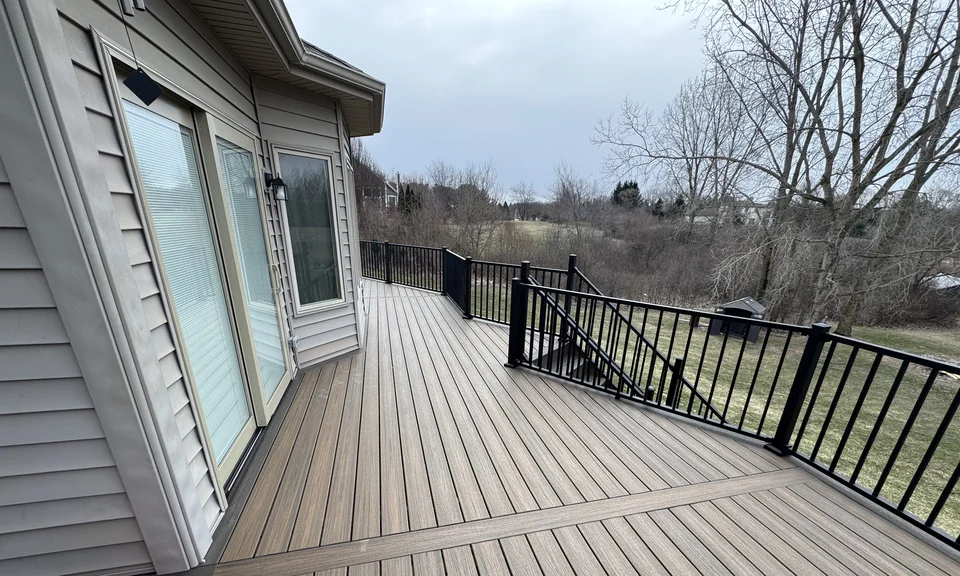
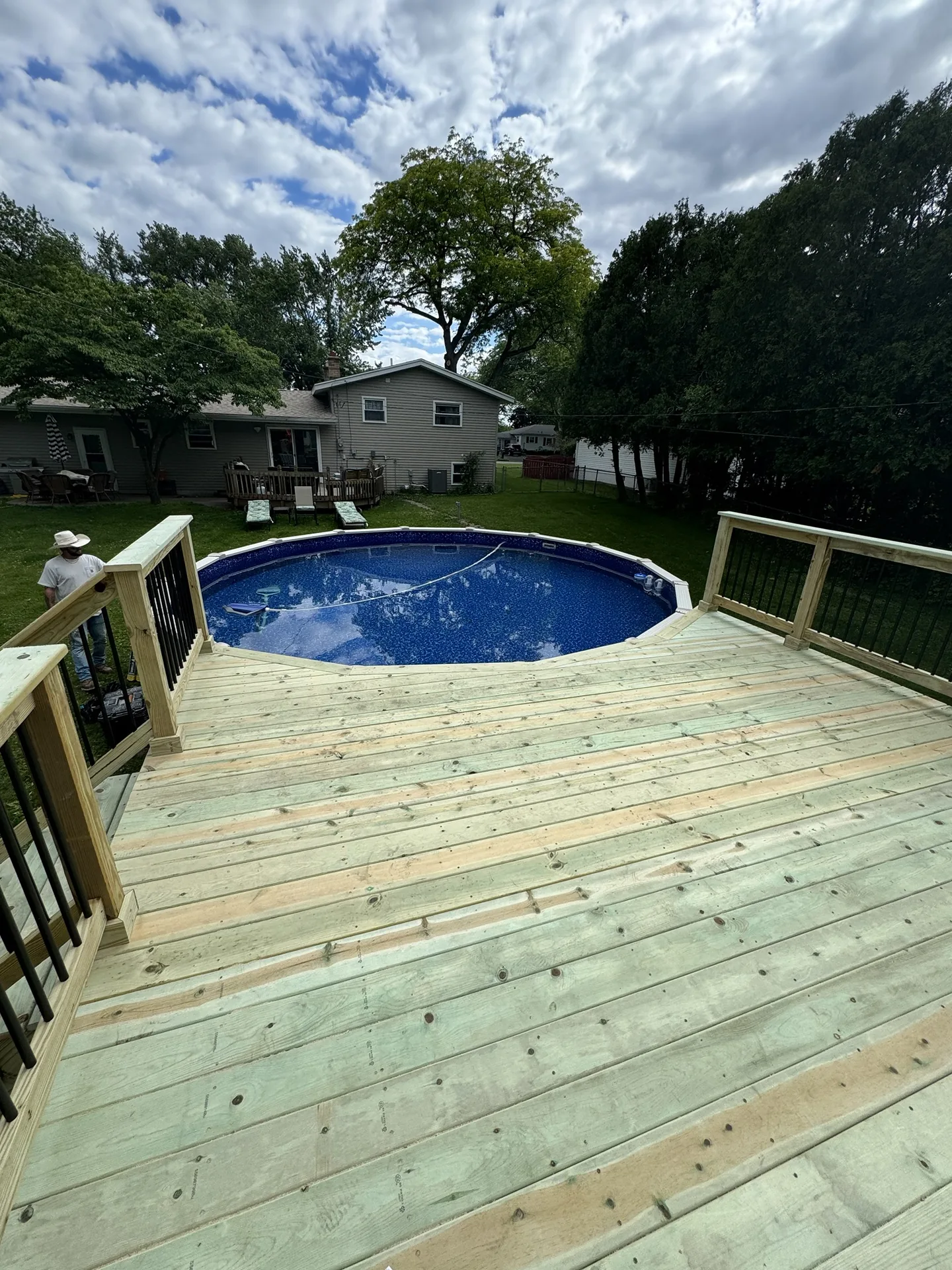
Our town pages show a few styles: black railings on a raised deck in Northville and black balusters on a pool deck in Canton.
When you compare quotes, ask each one to name the railing system, not just “metal” or “composite.” The same goes for the decking.
Wood or composite: the biggest choice you control.
Each material has its own range. Composite brands sell several product lines, and the top lines can cost noticeably more than the entry lines for a deck of the same size. Wood costs less to build but needs regular cleaning and sealing. Composite costs more at the start and needs less upkeep.
The choice can change the frame, too. Composite boards must be installed according to the manufacturer’s instructions, and Livonia’s deck guide says the same. Those instructions set how far apart the joists can be, so the board you pick can change the frame under it.
Tear-out: when an old deck comes off first.
If there is a deck there now, removing it is part of the job. The boards, railings and stairs come off first. That exposes the frame, so this is when any hidden damage shows up.
- How much comes off. Boards only, boards and railings, or everything down to the footings.
- Haul-away. The old material has to be removed and disposed of. A bigger deck means more to carry out.
- Permits for partial work. In some towns, even partial replacement needs a permit. Canton lists “any replacement of deck guardrails, deck boards, steps, or structure” as permit work. Plymouth Township lists permits for work to “install or repair” decks.
Ask every builder whether tear-out and haul-away are in the price.
What a photo cannot show.
Some costs only show up on site: soft or rotted framing under an old deck, damaged siding or sheathing where the deck meets the house, or a slope that changes the footings. Photos help us plan, but they cannot confirm whether an existing frame can be reused.
If we find hidden damage once work starts, we stop, explain the added work and what it will cost, and get your OK before ordering anything.
Permits: the steps that come with a deck.
Many decks need a building permit, and each city or township runs its own process. The steps take time and paperwork, so plan for them from the start. Here is what local towns ask for:
- The right office. The City of Plymouth notes that Plymouth Township is a separate municipality, often confused with City addresses, so check the project address first. In the City of Chelsea, a zoning permit from the City comes before the building permit from the Chelsea Area Construction Agency (C.A.C.A.).
- Plans and a plot plan. Canton asks for two plot plans and two sets of plans that show post, beam and joist sizes. Novi asks for two complete sets of plans with a plot plan, plus woodland and wetland affidavits and HOA approval.
- Inspections during the build. Canton requires a post hole inspection and a final inspection. Livonia’s guide lists a post hole and ledger inspection, an open joist inspection on decks with less than 4 feet between the joists and the ground, and a final inspection. Novi requires inspections of the exposed 42-inch-deep posts and of the completed deck.
- HOA approval. Canton says HOA approval, where it applies, must be obtained before construction.
When you compare quotes, ask each builder how drawings, plan review and inspections fit into the schedule.
How Brewers Homes prices a deck.
- You send the basics. Size, height off the ground, the material you are leaning toward, your town and a few photos.
- We prepare a sketch and samples. Tanner puts together a sketch of the deck, with color and railing samples to choose from.
- You get one clear price for that scope. The price covers the work as drawn. If the plan changes, we price the change before doing it.
How to get quotes you can compare.
Quotes only compare well when they price the same deck. Give every builder the same basics: the size, the height at the door, where the stairs go, the railing style, and wood or composite. Then check:
- Are both estimates for the same size, height and number of stairs?
- Do they name the actual decking and railing products, not just "composite"?
- Is tear-out and disposal of the old deck included?
- Who handles permits, drawings and inspections?
- How will hidden damage or changes be priced?
- Does the quote describe the frame, such as post spacing and beam and joist sizes?
Get a useful number faster.
Send these with your request and we can price the project without a long back-and-forth:
- Rough size, such as length and width in feet.
- Height off the ground at the door.
- Wood, composite, or not sure yet.
- A wide photo of the area, plus one of the wall where the deck would attach.
- Your city or township.
Deck cost questions.
How much does a 12x12, 14x20 or 20x20 deck cost?
It depends on more than size. Height, stairs, railing, wood or composite, and any tear-out can move the price as much as size does. We give one price for the scope shown in a sketch of your deck. To start, send the size, the height at the door, your material choice, your town and a few photos.
Why do online deck cost numbers disagree?
Most are averages. They mix different sizes, heights, materials and scopes, and some leave out stairs, railings, tear-out or permit work. A quote for your own deck, built to one plan, is the number to compare.
Does composite cost more than wood?
Up front, usually yes. Pressure-treated wood usually costs the least to build. Composite costs more, and premium composite lines cost more again. Wood needs regular cleaning and sealing, and composite needs less upkeep.
Do permits change what a deck project involves?
Yes. Many towns ask for plans and a plot plan before work starts. Canton, Livonia and Novi all inspect the post holes and the finished deck. Some towns, like Canton, need a permit even to replace deck boards. Our deck permits by town table compares 11 local towns.
Can you price a deck from photos?
Photos help us plan the sketch and the price. They can't show hidden damage or confirm whether an old frame can be reused, so that part is checked in person.
Ready to talk about your deck? Business line: 734-259-4649. Email: [email protected]. We serve homeowners within one hour of Plymouth, Michigan, including Plymouth, Canton Township, Livonia, Northville, Novi, Chelsea and Belleville.
Request an estimate734-259-4649