
Brewers Homes / Decks & covered porches / How long a deck lasts
Deck lifespan guide
How long does a deck last in Michigan?
Quick answer: There’s no single number. A 2007 home builders’ study puts wood decks at about 20 years under ideal conditions. TimberTech, which sells composite, says 25 to 30-plus years for composite. In Michigan the frame often decides: check the ledger, footings, fasteners and posts, because new boards can go on a sound frame.
Deck lifespan figures come from a home builders’ study, the companies that make decking, and the USDA’s wood researchers. This guide shows who says what, then covers the parts that usually decide when a deck is done, and how Michigan winters play in.
Call Tanner: 734-259-4649Request an estimate
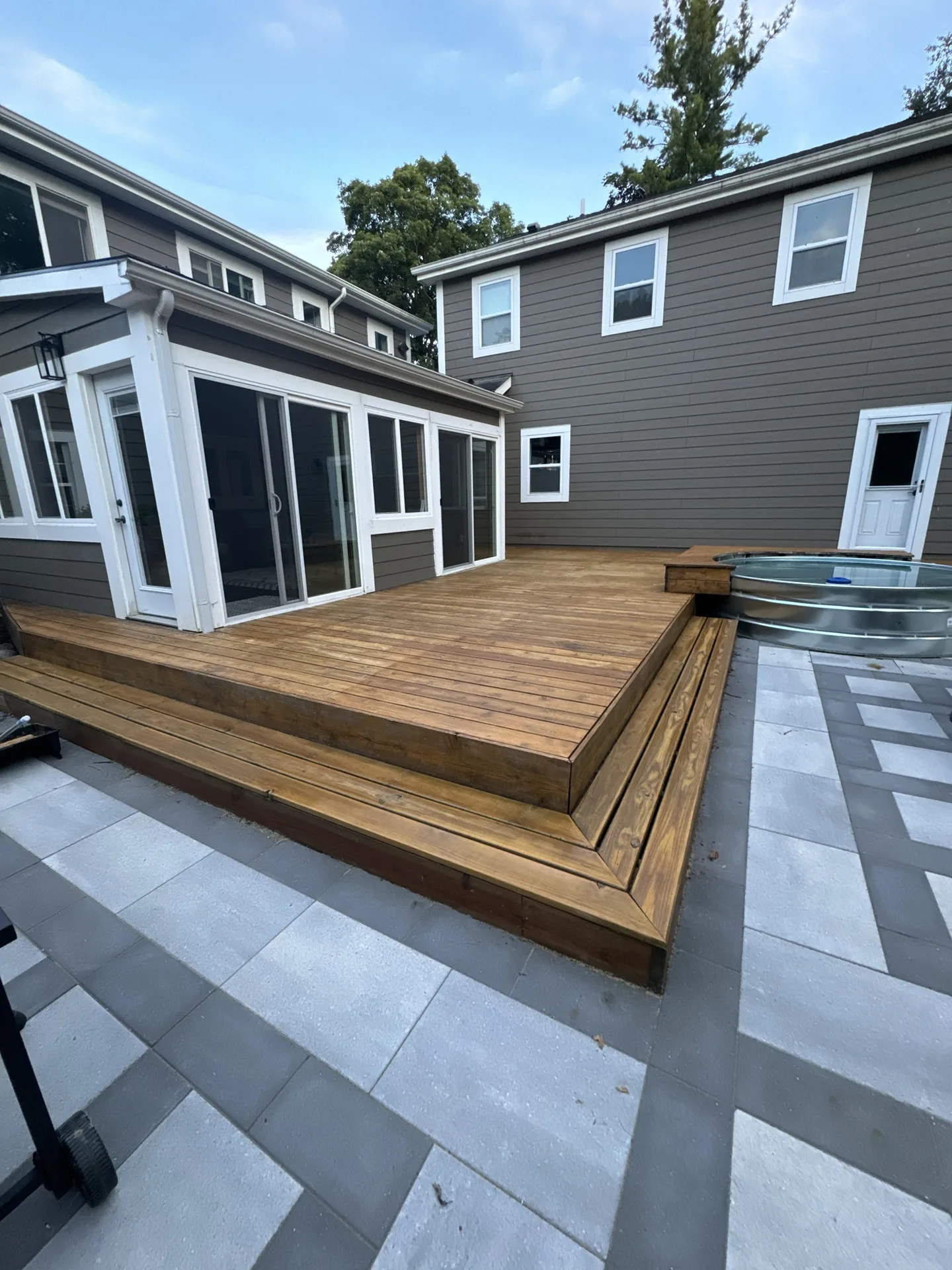
How long do wood and composite decks last?
| Source | Wood decks | Composite or PVC decks |
|---|---|---|
| National Association of Home Builders and Bank of America study (2007) | About 20 years under ideal conditions. The study says wooden deck life varies a lot by climate, and its table notes 20 to 30 years in the North. | Its table lists deck planks at 25 years without naming a material. |
| TimberTech (sells composite and PVC) | Typically 10 to 15 years. | Composite 25 to 30-plus years. Capped PVC as much as 50 years or more. |
| Trex (sells composite) | Not stated. | Its original 1998 boards are still installed in many homes after more than 25 years. |
| USDA Forest Products Laboratory | No year figure. Most decks are retired because of cracks and checks that timely finishing could mostly have prevented. | Not covered in its deck finishing guide. |
The study’s table credits Decks.com and TimberTech as its sources for decks, and the makers sell composite, so treat these figures as claims, not independent tests. We didn’t find a neutral, published lifespan figure for composite decking.
What’s under the boards matters too. Trex recommends pressure-treated lumber or steel for the framing under its boards, so most composite decks still stand on a wood frame. TimberTech says that when wood deck boards are replaced, problems in the frame often show up as well. For upkeep by season and how each material handles freeze-thaw, see our wood vs composite guide.
Which parts of a deck wear out first?
The sources we checked point to four parts that decide whether a deck has years left: the ledger, the footings, the fasteners and the posts.
- The ledger. The North American Deck and Railing Association (NADRA) calls the ledger board, where the deck attaches to the house, “a common source of deck failure.” It says the ledger shouldn’t be fastened with only nails, and that flashing should keep moisture and debris from collecting between the house and the ledger.
- The footings. Michigan’s residential code says exterior footings must extend 42 inches below grade, unless the building official approves a change for local conditions. That depth is about frost, covered below.
- The fasteners and connectors. NADRA says a corroded fastener can cause the wood around it to deteriorate, and suggests replacing rusted ones. The American Wood Council’s deck guide (DCA 6) requires corrosion-resistant hardware, such as hot-dipped galvanized or stainless steel, and says connectors exposed to some wood preservatives show high rates of corrosion in lab tests.
- The posts. DCA 6 says lumber in contact with the ground must be treated for ground contact, posts must be centered on their footings, and cut ends of posts must be treated with an approved preservative. NADRA’s checklist includes the support posts in its probe test for soft wood.
The boards take the weather head on. The Forest Products Laboratory says weather that shrinks and swells the wood leads to checks, cracks, raised grain and mildew, which raises the risk of decay and insect attack.
How do Michigan freeze-thaw cycles affect a deck?
Below ground, the concern is frost heave. The USDA’s National Soil Survey Handbook says it happens when ice lenses form in the soil and push it up, and that the soil loses strength when the ground thaws. It takes freezing temperatures, soil moisture and susceptible soil. Soils high in silt and very fine sand are the most prone.
The same handbook says frost heave is less of a problem for buildings whose footings extend below the depth of frost penetration, while driveways, patios and sidewalks can heave and crack. That’s one reason DCA 6 says deck stair stringers shouldn’t rest on a concrete pad or patio unless it is founded at least 12 inches deep or below the frost line, whichever is deeper.
How often does the ground freeze and thaw here? A study of southern Michigan soils by Isard and Schaetzl (1998) found that 3 to 5 freeze-thaw cycles a year are typical in eastern and southeastern southern Michigan. It also found that soil freezing depends more on how long and how deep the snow cover is than on air temperature.
What are the signs it’s time to replace a deck?
NADRA’s consumer checklist is the backbone of this list:
- Soft or spongy wood. Push an ice pick or screwdriver into damp spots and the wood around fasteners. If it goes in a quarter to half an inch easily, a sliver breaks off without splintering, or the wood feels soft and spongy, NADRA says decay may be present.
- Small holes in the wood, which NADRA says may point to insects.
- A ledger held on with nails only, or flashing that is loose or lets water collect.
- Rusted or corroded fasteners.
- Sagging or swaying. NADRA says the deck and stairs should look even and shouldn’t sway or move when tested.
- Loose railings, or stair stringers and risers that are loose or decayed.
- Checks and cracks across many boards, the reason the Forest Products Laboratory gives for most deck retirements.
One sign alone doesn’t always mean a whole new deck. If the frame is sound, new boards, railings or stairs may be enough. Our deck replacement guide walks through boards only vs a new frame. NADRA notes that its checklist doesn’t make a deck code compliant, and it suggests a deck builder or home inspector for a full evaluation.
How can I help a deck last longer?
- Look it over every year. TimberTech recommends an annual deck inspection, and our spring deck safety check is a walk-around you can do each spring.
- Keep a finish on wood. The Forest Products Laboratory recommends a penetrating finish on the walking surface and says a clear water-repellent preservative lasts about a year on exposed deck surfaces.
- Clear leaves and debris. NADRA says they can be slippery and promote mildew.
- Keep water away from the ledger. NADRA suggests adding or replacing flashing where water is collecting.
- Replace rusted fasteners with corrosion-resistant ones, as DCA 6 requires.
Questions people ask
How long does a wood deck last in Michigan?
A 2007 National Association of Home Builders study puts wooden decks at about 20 years under ideal conditions and says the range varies a lot by climate. Its table notes 20 to 30 years in the North. Regular finishing and a yearly check help.
How long does a composite deck last?
TimberTech, which sells composite decking, says 25 to 30-plus years. Trex says its original 1998 boards are still installed in many homes after more than 25 years. These are maker claims. The wood frame under most composite decks needs its own checks.
What part of a deck fails first?
There’s no single answer, but the sources we checked flag the ledger, the footings, the fasteners and the posts. NADRA calls the ledger, where the deck attaches to the house, a common source of deck failure.
Does freeze-thaw shorten a deck’s life in Michigan?
It can affect what’s under the deck. The USDA says frost heave happens when ice lenses form in moist, susceptible soil, and that it’s less of a problem for footings below frost depth. Michigan’s code sets exterior footings at 42 inches below grade.
How do I know if my deck needs replacing?
Look for soft or spongy wood, small insect holes, rusted fasteners, a ledger held on with nails only, loose railings, and sagging or swaying. If the frame is sound, new boards may be enough. A deck builder or home inspector can give a full evaluation.
Can I put new boards on an old deck frame?
Sometimes, if the frame is sound. TimberTech says that when wood deck boards are replaced, frame problems often show up too. Check the posts, beams, joists, ledger and footings before choosing new boards.
Sources
Checked: Nov 2026
Rules and product instructions change. Confirm with your building department and the care guide for your exact product.
- National Association of Home Builders and Bank of America Home Equity, Study of Life Expectancy of Home Components (Feb 2007), as reprinted in a Port of Seattle report appendix (PDF): https://www.portseattle.org/sites/default/files/2025-02/SEA-SIPP%20Technical%20Report%20Appendix%20C%20Life%20Expectancy%20of%20Building%20Materials.pdf
- TimberTech, How Long Does Decking Last? (Aug 6, 2025): https://www.timbertech.com/ideas/how-long-does-decking-last/
- Trex, Frequently Asked Questions: https://www.trex.com/why-trex/faq/
- USDA Forest Service, Forest Products Laboratory, Finishes for Wood Decks (Knaebe, 2013, PDF): https://research.fs.usda.gov/download/treesearch/32439.pdf
- NADRA, Check Your Deck consumer checklist (PDF): https://www.nadra.org/wp-content/uploads/2023/05/NADRA_DSM_Checklist.pdf
- American Wood Council, Prescriptive Residential Wood Deck Construction Guide (DCA 6, PDF): https://web-media.awc.org/wp-content/uploads/2022/02/17210514/AWC-DCA62015-DeckGuide-1804.pdf
- Mich. Admin. Code R 408.30522, minimum depth (Cornell LII): https://www.law.cornell.edu/regulations/michigan/Mich-Admin-Code-R-408-30522
- USDA NRCS, National Soil Survey Handbook, Part 618 Subpart A, 618.34 Frost Action, Potential (amended Aug 2024, PDF): https://directives.nrcs.usda.gov/sites/default/files2/1725389482/Part%20618%20Subpart%20A%20%E2%80%93%20General%20Information.pdf
- Isard and Schaetzl, Effects of winter weather conditions on soil freezing in southern Michigan, Physical Geography 19(1), 1998 (abstract): https://pure.psu.edu/en/publications/effects-of-winter-weather-conditions-on-soil-freezing-in-southern/
Text a photo of your yard to 734-259-4649 and Tanner will take a look.
Request an estimate734-259-4649