
Brewers Homes / Decks & covered porches / Snow and ice care
Winter deck care guide
Deck snow and ice care in Michigan
Quick answer: Clear snow from a deck with a plastic shovel, pushing along the boards, or use a brush or leaf blower for light powder. For ice, calcium chloride is the one melt Trex and TimberTech both allow on their composite decking. They disagree on rock salt. Clear the stairs first, and rinse melt off once the weather allows.
Deck board makers, a wood treatment maker and university extension services don’t all agree on snow and ice, so this guide shows who says what. The care guide for your exact decking has the final word.
Call Tanner: 734-259-4649Request an estimate
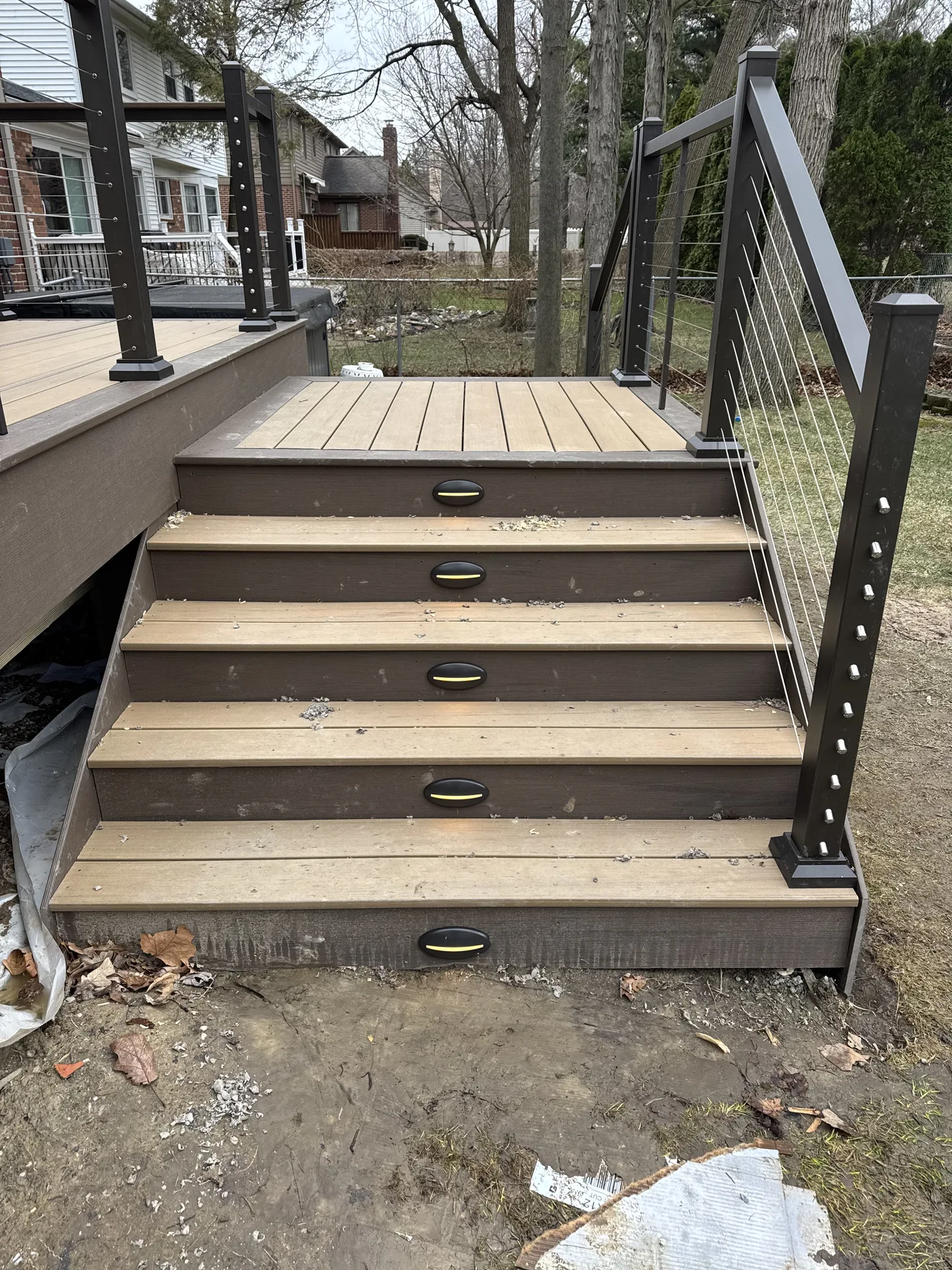
Do I need to shovel snow off my deck?
Not always. TimberTech recommends clearing all the snow from its decks but says it isn’t required, and that the moisture and weight won’t damage a properly installed TimberTech deck. It still suggests clearing fallen snow regularly to ease pressure and moisture on the boards.
Viance, a wood treatment maker, says to clear heavy-traffic areas of wood decks for safety, even when sealed. At a minimum, clear the door, the stairs and your path.
How do I shovel a wood or composite deck without scratching it?
- Use plastic. Trex says never to use a metal snow shovel on its decking, because a shovel can scratch the boards. TimberTech says to use an all-plastic shovel: metal shovels, and plastic shovels with a metal leading edge, damage its boards. It also suggests a shovel with a rubber blade.
- Push along the boards. Viance says to shovel parallel to the deck boards, since shoveling across them can catch the board edges.
- Brush light snow. For fresh, powdery snow, TimberTech says a brush or leaf blower can replace the shovel.
- Don’t chip at ice. Viance says banging on ice can dent a deck, and TimberTech says sharp ice can scratch its boards.
- Skip the sand. TimberTech and Viance both say sand is abrasive and can scratch decking. Iowa State and K-State extension pages suggest sand or cat litter for traction, but that’s for walks and drives, not deck boards.
Rock salt, calcium chloride or CMA: what can go on my deck?
Trex and TimberTech disagree on rock salt. Trex allows it on its decking. TimberTech says to avoid it. Here’s what each source says.
Scroll sideways to see every column.
| Ice melt | Trex (composite) | TimberTech (composite and PVC) | Wood decks |
|---|---|---|---|
| Rock salt (sodium chloride) | Allowed. Rinse it off when first practical. | Avoid. TimberTech says not to use rock salt on any deck, wood included. | TimberTech says no rock salt on pressure-treated or hardwood decks. Viance says to rinse any salt-based melt away once the ice melts, to protect fasteners and hardware. |
| Calcium chloride | Allowed. Rinse it off when first practical. | Allowed. Most calcium chloride products won’t damage the surface but can leave a white residue to clean off when temperatures allow. | Check the label and your stain or lumber maker’s directions. Viance says to make sure any melt is safe for wood decking. |
| Calcium magnesium acetate (CMA) | Not mentioned on Trex’s care pages. | Not mentioned on TimberTech’s care pages. | Not mentioned in the wood guidance we found. Ask the maker first. |
What the extension services say about the melts themselves:
- Rock salt melts ice only at about 12°F or warmer, and can damage unsealed concrete and nearby lawns and shrubs when too much washes off, according to K-State Research and Extension.
- Calcium chloride works down to about minus 25°F. K-State’s horticulture department calls it its first pick, for its low-temperature range and its gentleness on plants when used as directed.
- CMA contains no chloride. Iowa State’s extension service says it’s less damaging to metals and concrete and less toxic to plants. K-State says it melts ice only down to about 20°F.
Both extension services say to shovel first and use melt only to help. Iowa State suggests even less than the label recommends.
What do the American Wood Council and AWPA say about deicers?
We didn’t find deicer guidance from either. The American Wood Council’s deck guide (DCA 6) doesn’t mention ice melt, but it requires corrosion-resistant fasteners and connectors, such as hot-dipped galvanized or stainless steel, and notes that some wood preservatives speed up corrosion in lab tests. The American Wood Protection Association (AWPA), which DCA 6 says writes the voluntary standards for treated wood, had no deicer guidance we could find.
Iowa State says the chloride in most melts causes corrosion, so rinse salt-based melt off the deck and its hardware, as Viance advises.
How should I clear deck stairs and railings?
- Do the stairs first. They’re the way on and off the deck. Treads follow the same shovel and melt rules as the boards they’re made of.
- Don’t pile snow against the house. Livonia’s deck guide and the American Wood Council’s guide both call for flashing at the door threshold to keep out water from melting snow. Push snow off the far edge, away from the door and house wall.
- Keep salty snow off planting beds. Iowa State says salt can injure trees, lawns and shrubs, and suggests flushing the soil around plants with water in spring.
- Clean the railings after winter. TimberTech says to clean its composite and aluminum railing at least once a year and its PVC railing at least twice a year. In spring, push on each railing post too. Our spring deck safety check covers railings, stairs and handrails.
When is snow load a concern on a deck?
The American Wood Council’s deck guide sizes its framing for a 40 psf live load plus a 10 psf dead load (psf means pounds per square foot). It says it doesn’t apply to decks that see snow loads, drifting snow or sliding snow over 40 psf.
How heavy is snow? FEMA’s snow load guide says a foot of fresh snow weighs about 3 psf when light and dry and up to 21 psf when wet and heavy. An inch of ice weighs a little under 5 psf, and a foot of ice about 57.
Watch for:
- Deep, wet snow, or snow with layers of ice in it.
- Drifts that build up against the house or a railing.
- Snow sliding off the house roof onto the deck.
- A hot tub or other heavy item. DCA 6 says decks carrying large concentrated loads, such as hot tubs, are beyond its scope.
FEMA’s warning signs for overloaded roof framing include popping or creaking noises, sagging and cracked or split wood. If a deck shows any of these under snow, stay off it and have it looked at once it’s safe.
Choosing boards for a new deck? See our deck material and maintenance guide.
Questions people ask
Can I use rock salt on a Trex deck?
Trex says calcium chloride or rock salt can be used to melt ice on its decking. Rinse it off when the weather makes that practical, and use a plastic shovel, never a metal one.
Can I use rock salt on a TimberTech deck?
No. TimberTech says to avoid rock salt and abrasive ice melts and to use a calcium chloride product instead. Clean off any white residue once temperatures allow.
What ice melt is safe for a wood deck?
Check the label and your stain or lumber maker’s directions first. Viance says to choose a melt that is safe for wood decking and to rinse salt-based products away after the ice melts. TimberTech says not to use rock salt on pressure-treated or hardwood decks.
Is calcium magnesium acetate safe for composite decking?
Trex and TimberTech don’t mention it on their care pages, so ask your board maker before using it. Extension services say CMA has no chloride and is gentler on metal, concrete and plants, but it melts ice only down to about 20 degrees F.
Do I have to shovel my deck after every snow?
Not always. TimberTech says clearing all the snow isn’t required on a properly installed deck, but it suggests removing fallen snow regularly. Clear the door, the stairs and your walking path for safety.
How much snow is too much for a deck?
It depends on how the deck was built. The American Wood Council’s deck guide doesn’t cover decks that see snow loads over 40 pounds per square foot. FEMA says a foot of wet, heavy snow weighs about 21. Watch for drifts, ice and roof snow sliding onto the deck.
Sources
Checked: Oct 2026
Rules and product instructions change. Confirm with your building department and the care guide for your exact product.
- Trex, How to Clean a Trex Deck (snow and ice sections): https://www.trex.com/customer-support/trex-owners/care-and-cleaning/
- Trex, Frequently Asked Questions: https://www.trex.com/why-trex/faq/
- TimberTech, Let It Snow: Decking Care Tips for Winter (Nov 15, 2023): https://www.timbertech.com/ideas/snow-decking/
- TimberTech, 2026 Care and Cleaning Guide (PDF): https://assets.timbertech.com/content/dam/wp-content/TimberTech-Care-and-Cleaning-Guide.pdf
- Viance, Part 6: Snow and Ice Removal: https://www.treatedwood.com/woodchat/part-6-snow-and-ice-removal
- American Wood Council, Prescriptive Residential Wood Deck Construction Guide (DCA 6, PDF): https://web-media.awc.org/wp-content/uploads/2022/02/17210514/AWC-DCA62015-DeckGuide-1804.pdf
- K-State Research and Extension, ice melt product comparison (Jan 22, 2025): https://www.k-state.edu/news/wild-west-district/articles/2025/01/choosing-the-best-ice-melt-product.html
- Iowa State University Extension and Outreach, AnswerLine: Deicers, helpful or harmful? (reviewed June 2024): https://blogs.extension.iastate.edu/answerline/2019/01/24/deicers-helpful-or-harmful/
- FEMA P-957, Snow Load Safety Guide (Jan 2013, PDF): https://www.wbdg.org/FFC/DHS/femap957.pdf
- City of Livonia, Deck Guide (PDF): https://livonia.gov/DocumentCenter/View/2999/Deck-Guide-PDF
Text a photo of your yard to 734-259-4649 and Tanner will take a look.
Request an estimate734-259-4649